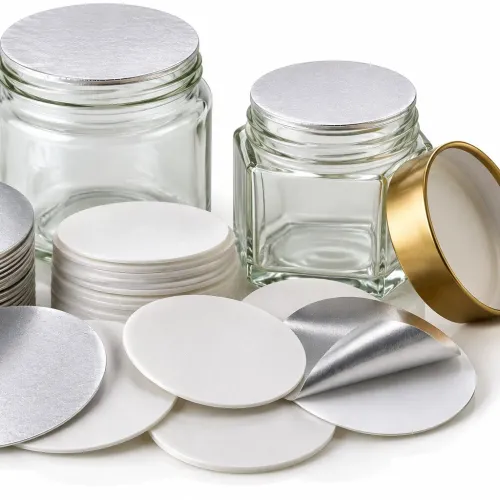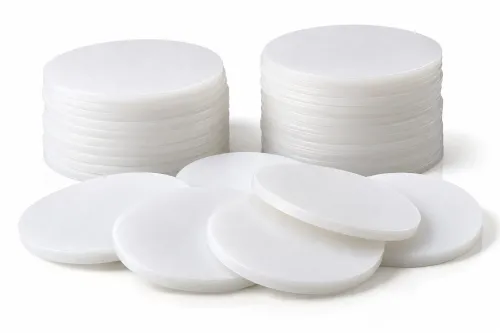
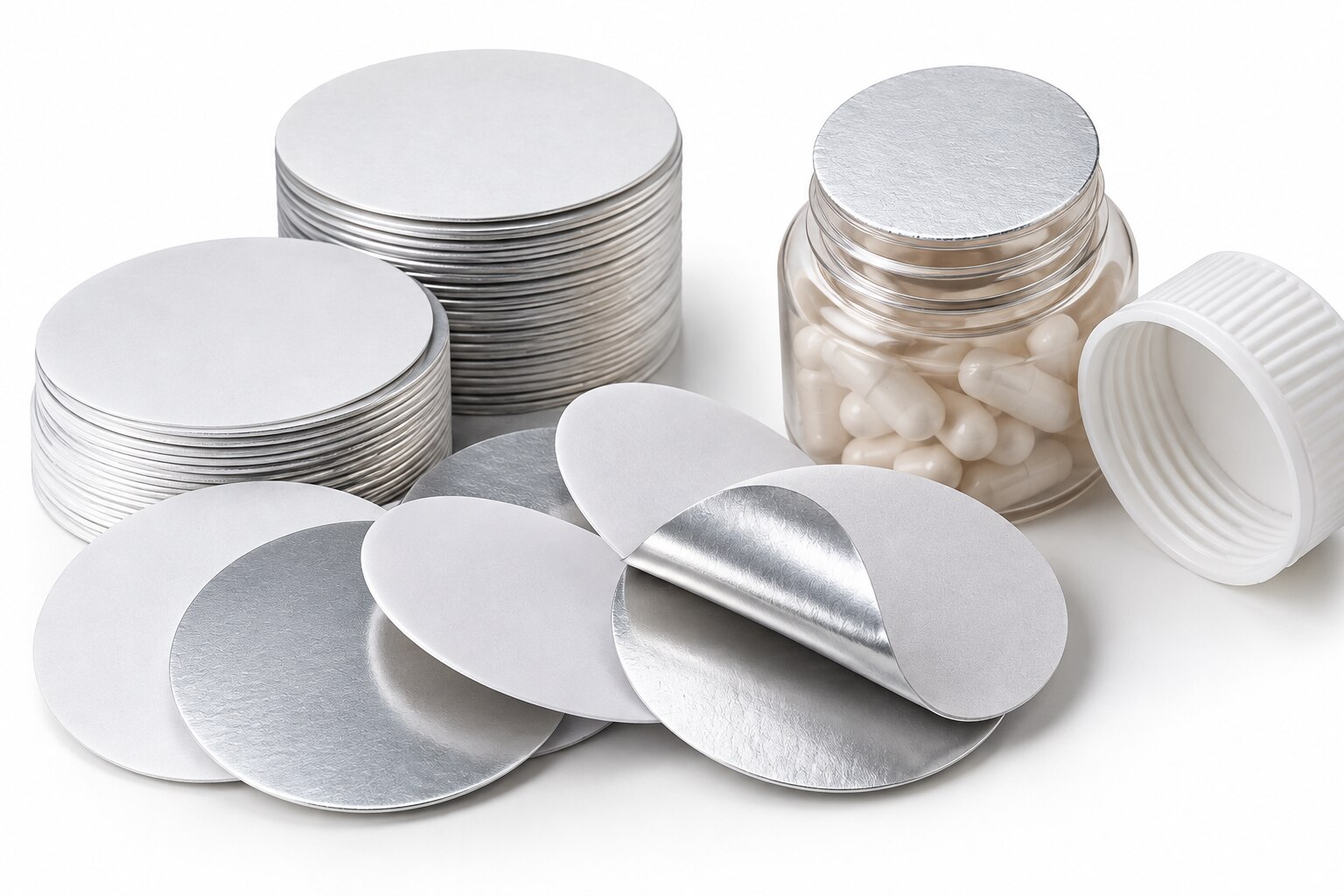
A bottle can look closed while its seal contains a channel leak, an unbonded section, or contamination trapped under the liner. You will learn how induction sealing creates the barrier, which container and process conditions make it reliable, and how to test the finished pack before release.
Key takeaways
- A continuous polymer bond to the bottle’s sealing land forms the barrier.
- Match liner construction, bottle material, cap fit, heat, speed, and pressure.
- Inspect for incomplete bonds, channel leaks, wrinkles, and false passes.
- Specify the sealing head and process window around your product and line.
How an induction sealing wad creates a leak and contamination barrier
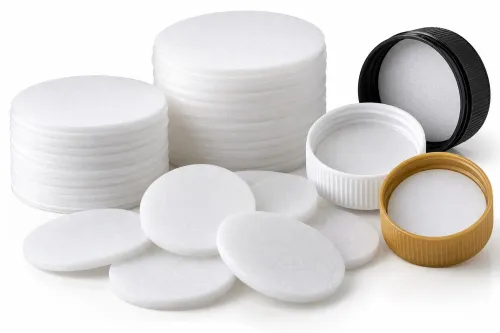
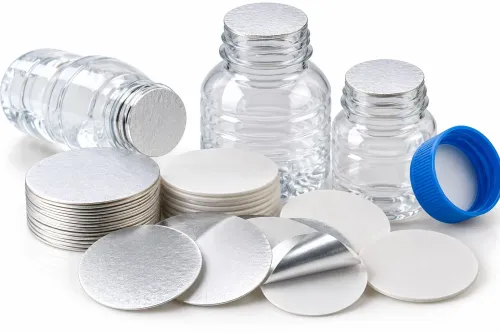
The finished barrier forms only when the liner’s polymer sealant layer bonds continuously to the bottle’s sealing land. Foil alone cannot seal: it acts as the heat source inside a multilayer wad, while a backing of pulpboard, foam, or paper supports the liner under the cap.
The induction sealing sequence is:
- Place the wad under the cap, with the sealant facing the container finish.
- Apply the cap at the specified torque so the liner contacts the entire land.
- Pass the closed container through the induction coil. The foil susceptor absorbs electromagnetic energy and heats the sealant locally.
- Allow the container to cool before testing. Cooling lets the polymer coating bond set rather than being disturbed during handling.
A sound polymer coating bond conforms to the finish and closes the continuous path around the neck. It stops liquid from escaping and limits oxygen ingress, dust, microbes, and other contaminants from entering.
The cap and wad also provide tamper evidence because removing the cap exposes, lifts, or tears the liner, but tamper evidence does not prove leak integrity; a pinhole or channel can remain hidden.
Keep the bottle land clean and dry. Syrup, oil, powder, or dust trapped under the seal prevents wetting, and extra induction power can damage the wad or container instead of repairing the defect. Induction heating forms the closure bond; it does not sterilize the product or reliably decontaminate residue beneath the liner.
Which container and process conditions determine seal quality
A continuous bond requires a compatible liner, a clean bottle land, and firm, even contact during heating and cooling. Match the sealant to the actual finish: an HDPE bottle, PET bottle, and glass container may require different coating formulations, even when their neck diameters match.
Test the complete combination of bottle, cap, liner, product, and production settings.
- Keep the land free of syrup, oil, powder, dust, and product particles. Residue creates channels that induction power cannot reliably close.
- Use the specified liner diameter and a cap that retains it flat against the finish. A warped neck, loose fit, excessive gap, or uneven land leaves an intermittent bond.
- Apply the cap within the specified cap torque range. Cap torqueом? Treat that as a question to resolve with measured torque, not as a substitute for a closure specification.
- Set power, exposure time or line speed, coil-to-cap distance, throughput, and closure pressure as one process window. Too little energy leaves an unbonded perimeter; too much can blister the laminate, burn through foil, or damage the sealant.
- Let the container cool before testing. Induction heat forms the bond; it does not sterilize residue trapped beneath it.
| Container material | What must match | What goes wrong if it does not |
|---|---|---|
| HDPE bottle | Sealant chemistry and finish geometry | Peeling or channel leaks |
| PET bottle | PET-compatible sealant and cap fit | Incomplete wetting or neck damage |
| Glass container | Glass-compatible sealant and even pressure | Weak bonding or local gaps |
How liner formats compare with other closure and sealing options
Choose a single-piece liner when you want a simple, tamper-evident seal and a straightforward consumer opening experience. Choose a two-piece liner when you need the seal to separate from a backing layer while the backing remains in the cap, reducing loose liner handling after opening.
| Option | What it means | When it applies |
|---|---|---|
| Single-piece liner | One assembled liner seals to the container finish as a unit | Use for compatible bottles when simple application, low part count and a clean opening matter |
| Two-piece liner | A seal layer bonds to the bottle while the backing layer stays with the cap | Use when cap retention, resealing convenience or a specified opening feel matters |
| Pressure-sensitive liner | Adhesive bonds the liner without induction heating | Use for dry products and moderate barrier demands when the container, adhesive and storage conditions are validated |
| Screw cap alone | Mechanical threads provide closure and spill resistance | Use when tamper evidence and a high oxygen, moisture or microbial barrier are not required |
Induction liners suit automatic capping because the cap applies and holds the liner during the heating cycle; the line still needs controlled torque, fit and cooling time. A pressure-sensitive liner can simplify equipment, but adhesive performance can deteriorate with dust, oil, humidity or product contact.
Do not choose by diameter alone. Match the sealant to HDPE, PP, PET or glass, then test the actual bottle, cap, product and settings for leakage and contamination resistance. Neither format makes the package permanently impermeable: bottle-wall permeation and cap leakage can still limit shelf life.
How to find incomplete bonds, channel leaks and false passes
An intact foil does not prove a continuous seal. An underheated seal can leave weak or unbonded sections around the bottle land, while an overheated liner can distort, burn, or lose polymer adhesion. Poor cap fit, excess gap, a warped finish, or inadequate liner retention creates the same misleading appearance.
Inspect every production change and investigate failures for:
- An incomplete perimeter bond, visible as areas where the polymer did not transfer to the container land.
- A pinhole or puncture in the foil.
- A channel leak: a narrow continuous path through wrinkles, contamination, or an unbonded edge.
- A loose wad or uneven imprint, indicating poor contact during heating or cooling.
- A cap that does not retain the liner firmly against the finish.
Use a test that matches the suspected failure. ASTM F2096 bubble test pressurizes the closed package and reveals gross leaks through escaping bubbles; it will not reliably find every narrow channel. Dye-penetration testing such as ASTM F1929 targets channels in specified package constructions. Neither test alone proves shelf-life integrity or microbiological protection.
| Method | Finds | Limitation |
|---|---|---|
| Visual and peel inspection | Missing transfer, wrinkles, scorching, incomplete perimeter bonds | Cannot expose every pinhole or closed channel |
| ASTM F2096 bubble test | Gross leaks under pressure | Not a complete test for fine channels or long-term integrity |
| ASTM F1929 dye test | Channels in compatible package constructions | Requires the specified materials and preparation |
| ASTM F88/F88M | Seal-separation force | Primarily suits flexible barriers, not a complete rigid-bottle leak test |
Repeat validation after hot-fill, retort, pasteurization, freezing, and transport-pressure cycles. Cooling can create vacuum loading, and temperature changes can alter polymer stiffness; an ambient pass can therefore become a failed package.
How to specify an induction sealing system for the product and line
Specify the system against the actual bottle, cap, product and line—not the wad diameter alone. Confirm the container resin and finish, cap material and torque range, liner retention, land width, fill level and whether powders, oil or syrup can reach the sealing surface.
Residue defeats bonding; more induction power can burn the wad without fixing a dirty finish.
Resolve these questions before requesting trials:
- Does the sealant bond to HDPE, PP, PET or glass used in production?
- What induction power, dwell time, line speed and coil-to-cap distance produce a continuous bond without blistering, neck distortion or foil burn-through?
- What cap pressure holds the liner against the land during heating and cooling?
- Does the product require a vented wad for vapour release or pressure control?
- Which market rules apply? Request food-contact declarations, migration or extractables data, lot traceability and, for pharmaceutical or chemical packs, the required compatibility and tamper-evidence records.
- What will validation cost: bottle and cap samples, destructive seal tests, line trials, changeover tooling, rejected packs and energy per thousand containers?
| Operating choice | Benefit | Failure risk |
|---|---|---|
| Short dwell, higher induction power | Suits faster line speed | Burn-through or laminate blistering |
| Longer dwell, lower induction power | Wider thermal control window | Limits throughput |
| Closer coil-to-cap distance | Transfers more energy | Container or cap overheating |
| Single-piece wad | Simple removal and reclosure | Lost barrier after removal |
| Two-piece wad | Backing can remain with cap | More components and fit checks |
Surya Products Limited can help compare standard and vented constructions against your bottle resin, closure fit and pressure requirements; demand production-setting trials, not a catalogue match.
Related products
 | INDUCTION SEALING WADS Paperboard, polyethylene and wax made two piece induction wads are reliable options for effective sealing of bottles and containers. View product → |
 | Single Piece Induction Wads Keeping track with the latest market developments, we are engaged in offering an extensive range of Induction Sealing Wads. View product → |
Frequently asked questions
How does an induction sealing wad prevent leakage and contamination?
The induction field heats the wad’s foil layer, which melts its polymer sealant and bonds continuously to the bottle’s sealing land. The bond blocks leaks, airborne contamination, and product exchange beneath the cap.
Which conditions determine induction seal quality?
Bottle material, sealing-land geometry, liner construction, cap fit, contact pressure, induction power, line speed, and cooling time determine seal quality. Keep the bottle mouth level and the liner centred across the land.
How can you identify an incomplete bond or channel leak?
Look for unbonded areas, wrinkles, lifted edges, broken rings, scorch marks, or residue paths across the seal. A pressure, vacuum, dye-penetration, or burst test can expose leaks that visual inspection misses.
What should you include when specifying an induction sealing system?
State the container material and diameter, cap and liner format, product sensitivity, target line speed, seal width, induction-head clearance, and required inspection or leak-testing method.
Related products
 | Holographic Induction Sealing Wads This is Two peice type induction sealing wads with HOLOGRAM or Holographic printing. View product → |
 | Vented Wads Designed as per health safety standard, these vented wads are used as reliable sealing options for HDPE and PET bottles containing chemicals. View product → |
 | Vented Sealing Wads This is a special type of induction wads with Vent or Air membrane provided for passing of Gases and hot air through membrane. View product → |
 | Sealing Wads Two peice tye Induction wads View product → |