
Pressure inside a sealed container can rise from heat, dissolved gas, chemical reaction, or product expansion, while cooling can create a vacuum. You will learn how a vented induction wad controls that pressure, how to distinguish controlled gas transmission from a liquid leak, and which tests and specifications to demand before selecting one.
Key takeaways
- Place the controlled vent over the container opening, not outside the neck land.
- Estimate pressure from temperature, fill volume, headspace, and product gas generation.
- Match vent capacity to the bottle, product, closure torque, and induction process.
- Test the finished package for leakage, venting, seal strength, and pressure limits.
What a vented induction wad contains and where the vent sits
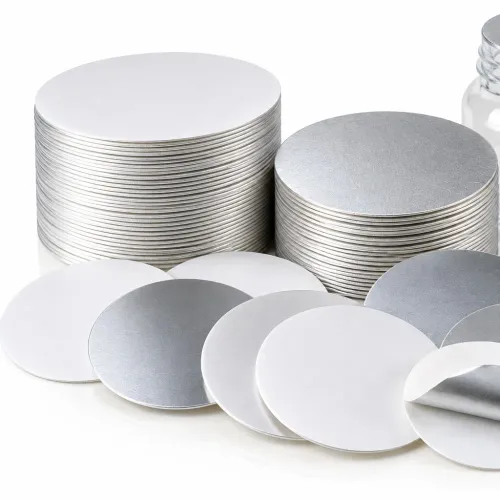
The seal is built from a bonded polymer layer carried by foil, while the vent is a separate, deliberately controlled route through the liner. This vented induction wad construction keeps the container liquid-tight around the neck land but allows gas to travel through a defined point over the container opening.
- Foil seal: the aluminium foil layer provides the induction-heated carrier and forms the main barrier to gas, moisture, aroma, and light.
- Polymer sealant: this heat-activated coating melts against the bottle’s neck land and creates the continuous bond that retains the product.
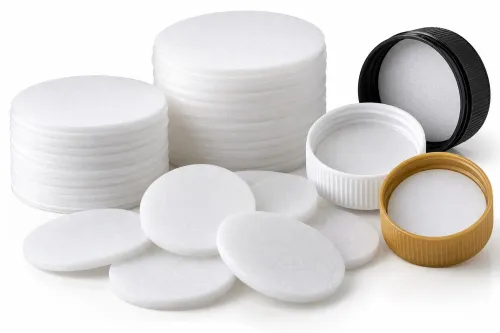
- Backing layer: paper, foam, or another support layer protects the liner during handling and can remain attached to the cap after sealing.
- Vent membrane: a porous, slitted, perforated, or valve-like element controls the gas path through the liner.
The vent membrane sits inside the circular bonded seal, over the bottle opening, rather than across the annular polymer-to-neck bond. A hole or channel in the foil and backing aligns with the membrane, creating a path from the headspace to the outside of the closed package.
The surrounding polymer sealant must remain continuous; a gap at its edge is a leak, not a vent.
The membrane design determines whether gas diffuses continuously, passes through an opening, or triggers a closing action. Induction heat must bond the sealant without melting, collapsing, or accidentally sealing the vent feature.
A nominal bottle sample is not enough: neck flatness, liner centering, cap compression, and closure dimensions can shift the vent away from its intended position.
How the vent equalizes pressure without releasing the product
A controlled vent lets gas move through the sealed wad while retaining the product as a liquid-tight seal. During induction sealing, air or headspace gas can pass through a vent hole, membrane, slit, or valve-like path when the pressure difference reaches the design threshold.
The sealant bonds the wad to the container mouth; the vent path remains separate from that bond.
During storage, gas transmission supports pressure equalization as the container warms, cools, changes altitude, generates gas, or absorbs gas into the product. A continuously breathable membrane permits ongoing movement. A pressure-activated structure stays closed until a specified differential pressure opens it, then restricts flow after the pressures approach balance.
- Gas movement: air and other gases cross the vent; vapor transmission depends on the membrane’s moisture and oxygen permeability.
- Product retention: the vent blocks liquid under the specified pressure, temperature, orientation, and handling conditions.
- Controlled venting: flow follows a measured conductance or opening pressure and remains within a stated liquid-leak limit.
- A leak: an unintended gap allows unrestricted gas flow and liquid escape, especially when the package is inverted, squeezed, or shaken.
A vent therefore reduces bulging, cap distortion, seal stress, or vacuum collapse without functioning as an unlimited pressure-relief device. ASTM D3078 bubble-emission and ASTM F2096 internal-pressurization tests can find gross leaks, but neither proves the vent’s gas-flow rate, equalization time, or liquid resistance.
Estimate the pressure your container will experience
A 20°C-to-60°C rise takes fixed-volume headspace pressure from 293 to 333 K—about 14% higher absolute pressure (333/293), before liquid expansion or container flex. Use this pressure buildup calculation as a starting point, not a specification; gauge pressure depends on starting pressure and package volume.
Headspace changes the result: less gas leaves less room for expansion, while dissolved carbon dioxide or oxygen can come out of solution as temperature rises or the package is shaken. Fermentation, oxidation, corrosion, or decomposition can generate gas continuously. Hydrogen peroxide packaging deserves particular review because decomposition can generate oxygen.
Hot filling can create positive pressure during filling, then vacuum as the product cools. Altitude changes external pressure: transport to higher elevation increases the pressure differential inside the pack, while reduced pressure during air freight can stress the seal.
- Record fill temperature, closure temperature, headspace volume, and initial headspace pressure.
- Model minimum and maximum storage temperatures, sunlight, freeze-thaw cycles, and the full transport route.
- Add gas generation, dissolved gas release, and liquid thermal expansion to the pressure buildup calculation.
- Test filled packs—not empty containers—through temperature cycling, reduced-pressure exposure, inversion, vibration, drop, and aging.
- Choose venting when the calculated pressure differential approaches the container or seal limit; check oxygen and moisture sensitivity because equalization can admit both.
Match the wad to the bottle, product, and closure process
A vented wad works only when the bottle, formulation, closure, and sealing cycle leave its gas path open while maintaining a liquid-tight bond. Start with the production bottle, not a nominal sample: HDPE versus PET changes stiffness, thermal expansion, and neck-land behaviour.
Confirm the neck finish, diameter, land flatness, cap liner compatibility, liner centering, cap torque, and compression range before selecting the wad.
| Container | Selection check | Risk if mismatched |
|---|---|---|
| HDPE | Allow for flexible walls, dimensional variation, chemical exposure, and torque-induced neck deformation | Uneven compression can block the vent or weaken the bonded seal |
| PET | Check heat exposure, neck stability, and stress cracking against the formulation | A rigid or distorted finish can reduce bonded area or damage the seal |
| Either | Match wad diameter and vent location to the actual neck finish and cap | An off-centre liner can cover the vent or leave an unsealed edge |
Check these variables before production approval:
- Test the actual formulation, including powders, solvents, oils, surfactants, viscous liquids, residues, and crystallising ingredients. Chemical compatibility must cover the sealant, membrane, liner, and product over the intended storage temperature.
- Match induction power, dwell time, line speed, and cooling conditions to the wad’s induction energy window. Excess heat can deform the liner; insufficient energy leaves channels.
- Reject a vented wad as the sole pressure control for carbonated or actively fermenting products unless its vent rate, opening behaviour, and carbonation retention are engineered and proven.
- Ask Surya Products Limited for gas-flow data, liquid-leak limits, temperature limits, and the test method, then qualify filled production packs after torque, inversion, vibration, and temperature exposure.
Specify performance limits and qualify the finished package
Approve the finished package against measured limits, not the word “vented.” Specify the maximum pressure differential, venting rate at stated pressure and temperature, opening pressure, pressure-equalization time, liquid-leak limit, oxygen and moisture transmission, temperature range, chemical-compatibility limits, and induction energy window.
Request these values for the actual bottle, closure, formulation, and fill level:
- Pressure cycling must show that the vent controls pressure without exceeding the container’s rated differential.
- Inversion and shaking must produce zero visible liquid leakage; vapor transmission is a separate result.
- Temperature cycling, reduced-pressure exposure, vibration, drop testing, and filled-package aging must use sealed packages.
- Retest after product contact to detect membrane blockage, swelling, embrittlement, or sealant attack.
| Test | What it can prove | What it cannot establish |
|---|---|---|
| ASTM D3078 bubble-emission | Gross leaks under a specified vacuum challenge | Venting rate, opening pressure, equalization time, or long-term liquid retention |
| ASTM F2096 internal pressurization | Gross leaks revealed by bubbles during pressure testing | Whether the vent opens at the intended pressure or transmits gas at the required rate |
| Pressure-and-retention protocol | Measured pressure decay, equalization time, liquid leakage, and post-transport integrity | Results outside the stated container, product, temperature, and closure conditions |
Set acceptance criteria before testing. A package that passes ASTM D3078 and ASTM F2096 can still vent too slowly, admit oxygen during cooling, or lose carbonation. Carbonated and actively fermenting products require a pressure-rated closure unless the vent’s opening behaviour, gas loss, and long-term seal performance are specifically validated.
Frequently asked questions
What does a vented induction wad contain, and where does the vent sit?
It contains a bonded polymer sealing layer carried by foil, with a separate controlled vent positioned over the container opening. The seal remains liquid-tight around the neck land.
How does a vented induction wad equalize pressure without releasing the product?
The defined gas path allows pressure-driven gas movement through the vent while the bonded polymer layer seals the neck land against liquid leakage.
How do you estimate the pressure a container will experience?
Assess temperature changes, fill volume, headspace, product gas generation, transport conditions, and the bottle and closure pressure ratings.
How do you match a vented wad to the bottle, product, and closure process?
Check the neck finish, sealing surface, product chemistry, required vent rate, closure fit, induction settings, and line speed before selecting and testing the wad.
What performance limits should you specify for a vented induction wad?
Set limits for leak resistance, venting rate, seal strength, pressure and temperature exposure, chemical compatibility, and induction-process consistency, then qualify the complete package.